If an earthquake hits in Japan, protect your head and wait for the shaking to stop.
3 things a big family sets up on the day they arrive
If you feel an earthquake in Japan, the basics are to protect your head first, wait for the shaking to stop, and not rush outside. On the day a family of 6 arrives in Japan, there are 3 things to do: install the Japan Tourism Agency's app "Safety tips", decide where to meet if you get separated, and decide how you will get in touch.
*This article contains no affiliate links. It is compiled neutrally from public sources and official information.
Arrival day3 things to set up on the day you arrive
If you come from a country with few earthquakes, a phone suddenly blaring may leave you not knowing what has happened, and unable to move. When 6 of you are on the move, there will also be times when the children and grandparents are in different places. This article is not meant to frighten you; it is for deciding in advance what each member of the family will do when the ground shakes.
The answer: when you arrive in Japan, install Safety tips, choose 2 meeting points for the 6 of you, and decide how you will get in touch. You can do all of it together on the evening you reach your hotel.
1. App: install Safety tips Japan Tourism Agency
A free app for foreign travellers, supervised by the Japan Tourism Agency. It sends notifications of earthquake early warnings, tsunami warnings, evacuation information and more, and has step-by-step guides on what to do in each kind of place, plus point-to-talk communication cards.
2. Meeting points: choose 2 Our suggestion
"The hotel" and "a large open space near the hotel (one with an evacuation-area sign)". Decide the second as well, for when you can't get back to the hotel.
3. Contact: decide how Prime Minister's Office guidance
How family phones will reach each other (a messaging app, for example), and 171 / web171 for when calls don't go through (see below). Give each child a slip of paper with the hotel's name and address.
- The Prime Minister's Office guidance also recommends deciding how your family will check on each other's safety and checking where evacuation areas are.
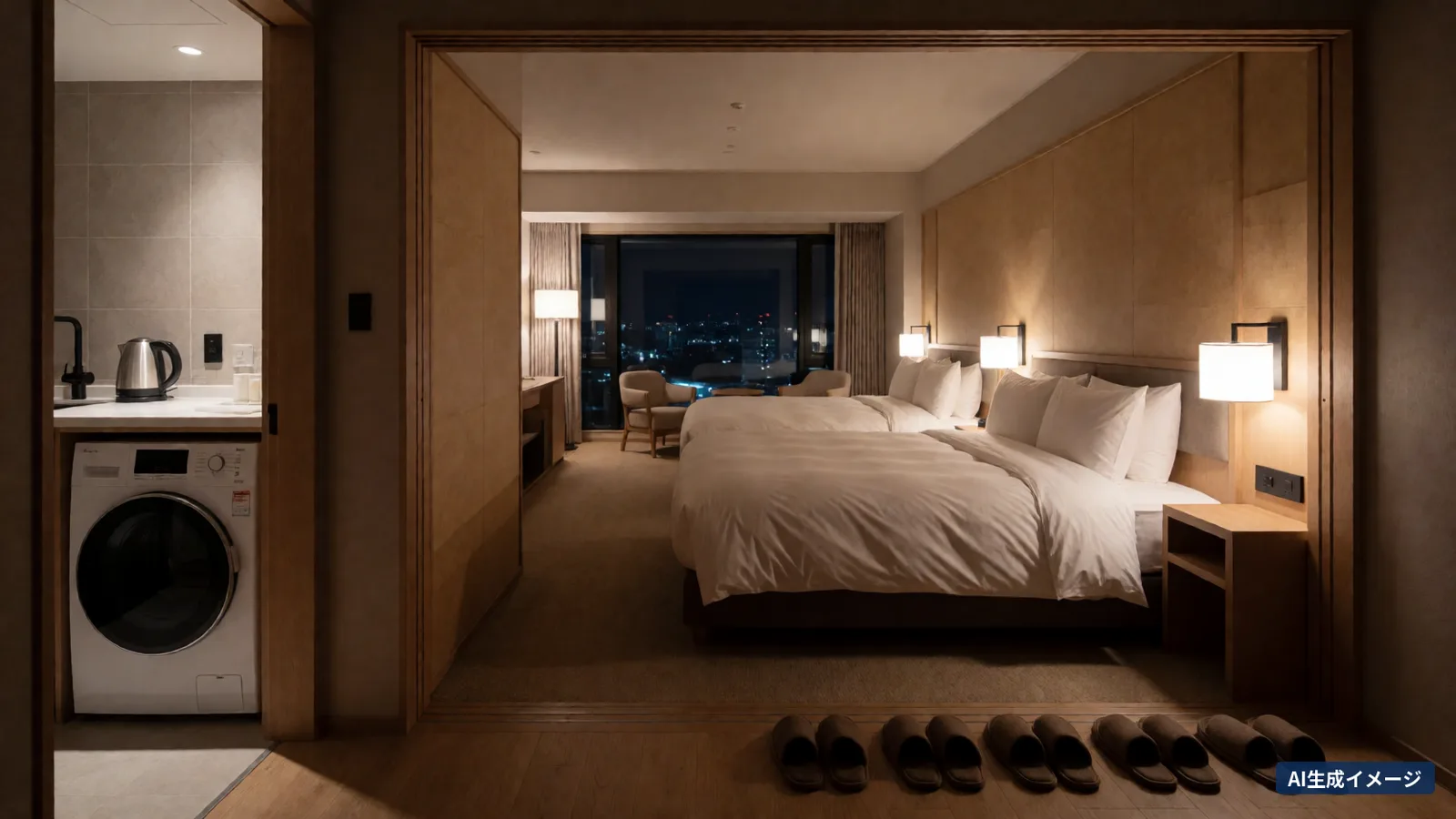
- When you reach your hotel, walk the route from your room to the emergency exit once as a family (Safety tips' hotel section: "check the emergency exits in advance").
- Decide in advance which of the 4 adults stays with which child. While the ground is shaking, whichever adult is nearest protects their head together with the child next to them.
- Once the shaking stops, staff and hotel instructions come first, as does evacuation if you are near the sea or a river (see the table of places below). After that, the family meets up at the meeting point you chose.
| Family | While it shakes | Once the shaking stops |
|---|---|---|
| 2 parents | Each protects their head together with the nearest child | Count the family and listen to the hotel or staff |
| 2 grandparents | Protect their head where they are; don't run after the children | Follow staff where they are, and meet the family at the chosen meeting point |
| 2 children | Protect their head beside the nearest adult | Stay by the nearest adult or member of staff, and go to the meeting point with an adult |
- On nights when the 6 of you are split across 2 rooms, protect yourselves in your own rooms while it shakes, and meet up in the corridor only after the shaking stops and the hotel has given instructions.
- If the hotel's notices or announcements are only in Japanese and you can't follow them, ask hotel staff using the point-to-talk communication cards in Safety tips.
Safety tips: a free app in 15 languages, including English and Traditional Chinese
The answer: Safety tips is a free app from the Japan Tourism Agency, available in 15 languages including English and Traditional Chinese. There is no French display, so French-speaking families use it in English.
- It has been available since October 2014 (Japan Tourism Agency materials). JNTO's website also has a page introducing it.
- The 15 languages: English, Chinese (Simplified), Chinese (Traditional), Korean, Japanese, Spanish, Portuguese, Vietnamese, Thai, Indonesian, Tagalog, Nepali, Khmer, Burmese and Mongolian (Japan Tourism Agency page, updated April 2026).
- What it notifies: earthquake early warnings, tsunami warnings, weather emergency warnings, eruption alerts, evacuation information, heatstroke information and civil protection information.
- "Response flowchart": answer "Where are you now?" and it shows what to do by place, such as inside a building, outdoors or on transport.
- "Communication cards": example phrases for pointing at during a disaster.
- Check supported OS versions in each app store.
Earthquake early warning: when your phone sounds, shaking comes within seconds to tens of seconds
The answer: an earthquake early warning is an alert the JMA issues before strong shaking arrives. When phones sound with the shared loud tone, protect your head where you are. You have only a few seconds, or at most a few tens of seconds, before the shaking.
- The JMA issues a warning to areas where strong shaking is expected, for example when a maximum seismic intensity of 5-lower or more is forecast.
- Delivery to mobile phones: NTT docomo, au, SoftBank, Y!mobile and Rakuten Mobile. The alert tone is a sound shared by all carriers, separate from the one used on TV and radio.
- On TV, NHK broadcasts it nationwide, and many stations use NHK's chime.
- Close to the epicentre, the warning does not arrive before the shaking. Even if no warning sounds, do the same thing when you feel shaking.
- The forecast intensity has a margin of error; the actual shaking may be weaker or stronger than forecast.
- The official sites of the JMA, the mobile carriers and the Japan Tourism Agency give no guarantee that Japan's warnings reach foreign phones or foreign SIMs. Assume they may not, and install Safety tips.
- You can't receive it with the power off, in airplane mode, or where the signal is weak (docomo guidance).
While it shakes: what to do in each place
The answer: wherever you are, the basics are to protect your head first and not move until the shaking stops. Don't rush for the outside or the exits.
| Place | While it shakes | Once the shaking stops |
|---|---|---|
| Hotel room | Protect your head and get under a sturdy table | Open the door to secure a way out and follow the hotel's instructions. Don't rush outside (indoors can be safer) |
| Lift | Press every floor button and get out at the floor where it stops | If you are trapped, use the emergency call button to reach help, and wait calmly to be rescued |
| Train or bus | Hold a handrail or strap and protect your head (the emergency brake may be applied because of the shaking) | Follow the crew's instructions. Don't get down onto the tracks yourself |
| Underground mall or station | Protect your head and wait for the shaking to stop | When the emergency lights come on, walk along the wall and follow staff instructions. Don't crowd the exits |
| Station, airport or shop | Protect your head and move to an open space where nothing can fall, or beside a pillar that won't fall | Follow staff instructions. Don't escape by a lift that hasn't been checked as safe |
| In the street | Protect your head with a bag. Keep away from block walls, vending machines, signs and glass | Go to an open space with the people around you |
| Driving (rental car) | Don't brake hard; turn on your hazard lights and slow down gently. If it shakes hard, stop on the left side of the road | Watch for aftershocks, and move only after checking it is safe |
| Near mountains or cliffs | Watch for falling rocks and landslides | Keep watching for falling rocks and landslides even after the shaking stops |
| Coast or riverside | Protect your head | Go straight to high ground or a tsunami evacuation area (next section) |
- In every case the last step is "watch for aftershocks and secondary disasters, and go back to the hotel after checking it is safe" (Safety tips).
- Even if the 6 of you are in different places, protecting yourself comes first. Move to look for family only after the shaking stops.
- For precautions on days you walk near a volcano, see Owakudani with kids: the 2 official volcanic gas levels.
When the trains stop
The answer: when a train stops, wait on board for the crew's instructions. Service resumes on sections that have been inspected and confirmed safe; there is no set number of minutes before it moves again.
- Opening the doors yourself and getting down onto the tracks is dangerous (Safety tips).
- Tokyo Metro, for example, restricts service immediately according to the size of the earthquake and resumes on sections confirmed safe by inspection. In a large earthquake it guides passengers to safe places in stations to wait, and keeps drinking water, foil blankets, portable toilets and other supplies at stations.
- With children and grandparents, don't set off on a long walk from the station; wait for station staff guidance.
Tsunami: learn the colours and shapes of the signs
The answer: if a tsunami warning is issued while you are near the sea or a river, head straight for high ground or a tsunami evacuation building. Tsunamis come again and again, so don't go back to the water until the warning is lifted.
- When a major tsunami warning or tsunami warning is issued: people on the coast or along rivers go straight to a safe place such as high ground or an evacuation building (JMA).
- When a tsunami advisory is issued: anyone in the sea gets out at once and moves away from the shore (JMA).
- Tsunamis also travel up rivers (Safety tips).
- The signs (Japanese pictograms): a tsunami evacuation area is white on green, a wave and a person running to high ground; a tsunami evacuation building is white on green, a wave and a person running into a building; tsunami caution is a black wave in a yellow triangle.
- Precautions for days at the sea (typhoons, rip currents and more) are covered in Okinawa jellyfish season and typhoons: family safety.
Evacuation areas and evacuation shelters are different places
The answer: the place to flee to first in an earthquake or tsunami is a "designated emergency evacuation area". A "designated evacuation shelter" is a facility for staying a certain period afterwards.
- The Geospatial Information Authority of Japan advises evacuating to a designated emergency evacuation area, not a designated evacuation shelter, when a disaster strikes.
- Each municipality designates evacuation areas by type of disaster (8 types, including earthquakes, tsunamis, large fires and floods). The signs show with ○ (suitable) and × (not suitable) which disasters the place is suitable for.
- The shapes on the signs: an evacuation area is a person running towards a green oval; an evacuation shelter is a running person inside a green house shape.
- On the GSI's map service, GSI Maps, you can see evacuation areas by type of disaster.
- Osaka Prefecture, together with Osaka City, has agreements with hotels and inns in the city to take in travellers stranded by a disaster for a short time. Kyoto City lists emergency evacuation areas (temples, shrines and others) where tourists can stay for a short time.
If the 6 of you get separated: ways to get in touch
The answer: when calls are hard to get through, use the Disaster Emergency Message Dial 171 and the Disaster Emergency Message Board (web171). If you are in trouble, JNTO has a 24-hour phone line.
| Method | What it does | Languages |
|---|---|---|
| Disaster Emergency Message Dial 171 | Leave and listen to voice messages (up to 30 seconds each). Starts in large disasters when calls are hard to get through | Voice guidance is in Japanese (we found no foreign-language voice guidance in official information) |
| Disaster Emergency Message Board (web171) | Leave and read messages on the internet | Instructions available in English, Chinese (Simplified) and Korean |
| 00000JAPAN | A shared Wi-Fi name under which public Wi-Fi that is normally paid is opened free in a disaster | The connection is not encrypted, so don't send card numbers or passwords over it (MIC) |
| Japan Visitor Hotline (JNTO) | 050-3816-2787 (from Japan), +81-50-3816-2787 (from abroad). 24 hours, 365 days. Support in accidents, illness and disasters, plus tourist information | English, Chinese and Korean |
- 171 and web171 can be tried out on set days such as the 1st and 15th of each month. If the dates line up, try them once as a family during your trip.
- JNTO's X (formerly Twitter) account "@JapanSafeTravel" and its "Japan Safe Travel Information" page post information after earthquakes of intensity 5-lower or more, among other events.
- The JMA has earthquake and tsunami information pages in 15 languages (including Traditional Chinese; there is no French).
- In Osaka, the Osaka Convention & Tourism Bureau's tourism site "OSAKA INFO" has information for travelling safely in 10 languages (Osaka Prefecture guidance). Osaka Prefecture also publishes a disaster-preparedness guide (leaflet) for foreign travellers, with English, Chinese (Simplified and Traditional), Korean and Japanese side by side on one sheet; there is no French (February 2024 edition). If you are staying in Osaka, look at it while you prepare.
- How to prepare for summer heat and sudden heavy rain is covered in Surviving summer in Japan with a large family.
Honest caveats (6 things we could not confirm or did not cover)
These are things we have not been able to verify, so we do not assert them.
Whether alerts reach foreign phones
Official sources give no guarantee that Japan's earthquake early warnings reach foreign phones or foreign SIMs.
Safety tips languages
As of October 2026 it supports 15 languages, and French is not one of them. This may change.
Travellers and evacuation shelters
We found no official national statement setting out, for the whole country, whether travellers can stay in evacuation shelters.
Foreign languages on 171
We found no foreign-language voice guidance for the Disaster Emergency Message Dial 171.
Guidance from each railway
Of the railways' guidance for earthquakes, this article checked only Tokyo Metro's.
What we don't cover
This article does not cover the probability of earthquakes or the scale of damage. It covers only how to act when the ground shakes and how to prepare.
If an earthquake hits in Japan (with kids) FAQ
Our phones made a loud noise. What should we do?
It may be an earthquake early warning. Strong shaking is only seconds to tens of seconds away, so protect your head where you are and wait for the shaking to stop somewhere nothing can fall on you, such as under a table. Don't run outside.
Do earthquake early warnings reach foreign phones?
There is no official guarantee that they do. If you install the Japan Tourism Agency's free app Safety tips, you can get earthquake early warnings and tsunami warnings as notifications.
If it shakes while we are in our hotel room, should we get outside straight away?
The basic rule is not to rush outside. While it shakes, protect your head; once it stops, open the door to secure a way out and follow the hotel's instructions. Walk the route to the emergency exit as a family on the day you arrive.
We got separated from our family and calls won't go through.
Go to the meeting point you chose in advance. You can leave messages on the Disaster Emergency Message Dial 171 (voice in Japanese) or on the Disaster Emergency Message Board web171, which has instructions in English. If you are in trouble, call JNTO's Japan Visitor Hotline (050-3816-2787, 24 hours, English/Chinese/Korean).
📍 One of the articles in our Namba trip plan (Namba & Osaka Castle | Trip plan for large families / all tips articles)