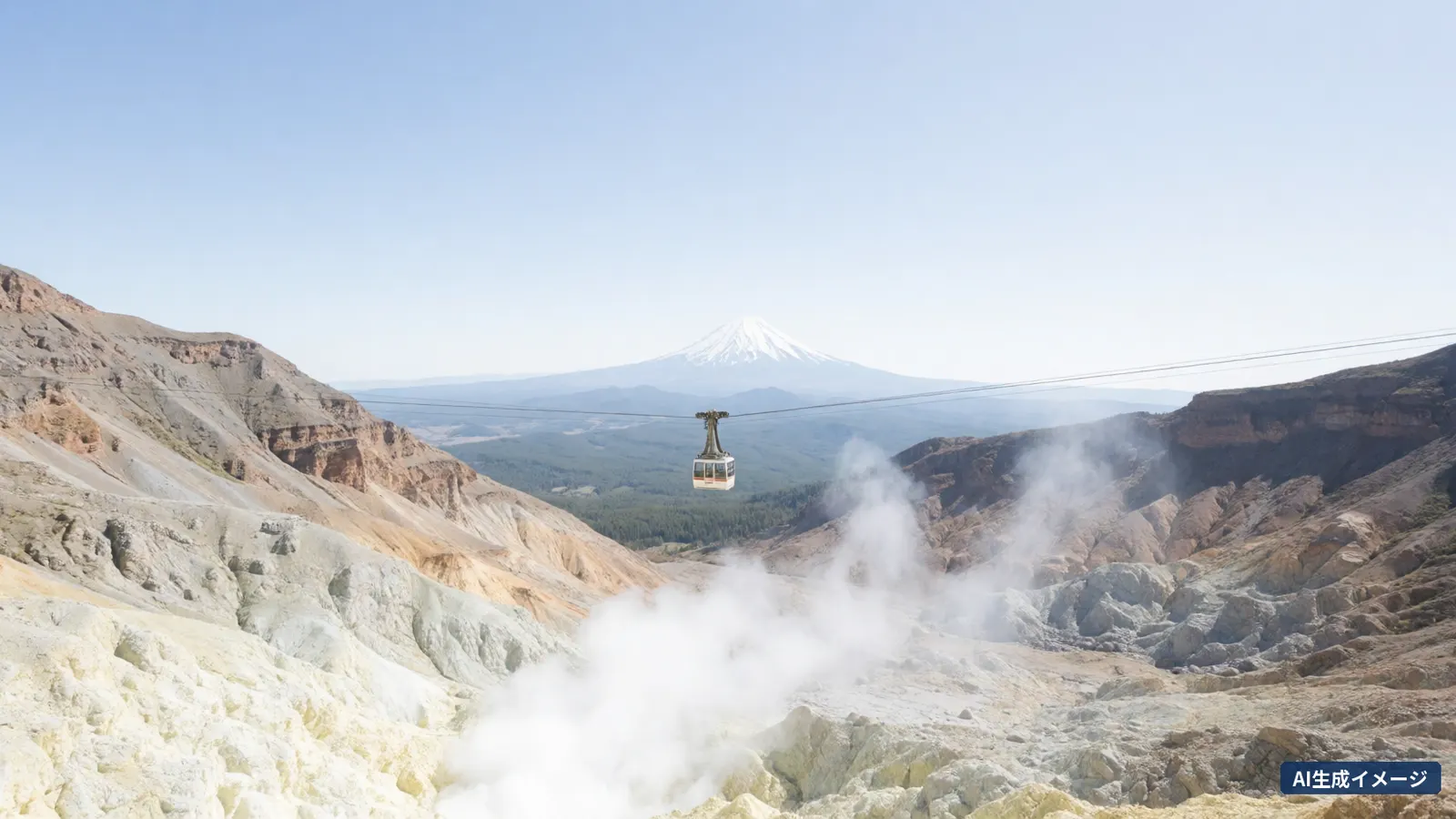
You can take kids to Owakudani.
Who stays on board is decided by two official levels.
Owakudani is the volcanic valley in Hakone that you reach by ropeway, famous for its black eggs. But it gives off volcanic gas, so not everyone in the family can necessarily ride the ropeway and get off. Who does not ride, or does not get off, is decided by the official guidance, so here are its two levels and how to split up and meet again.
*This article contains no affiliate links. It is compiled neutrally from public sources and official information.
The official linesOwakudani's official guidance has two levels
The answer: the guidance for Owakudani names "people who cannot ride the ropeway or sightsee at Owakudani" and "people who should consider not riding or not getting off". The two are very different in strength.
Original wording checked on the official pages of Hakone Ropeway (Hakone Navi) and the Kanagawa Park Association in September 2026. This article does not make medical judgements. Ask your family doctor which level a relative's condition falls under.
| Level | Who | What the official guidance says | Source |
|---|---|---|---|
| Cannot (ropeway) | People with allergic asthma, bronchial conditions, respiratory (lung) conditions or heart conditions, people with a pacemaker, and people who feel unwell | Because it is life-threatening, they cannot ride the ropeway between Sounzan and Ubako | Hakone Ropeway |
| Cannot (Owakudani) | The same 6 groups | Because it is life-threatening, they cannot sightsee outside the vehicle | Kanagawa Park Association |
| Consider (ropeway) | Pregnant people, sensitive people including newborns and small children, people with allergies, and older people | Because even a tiny amount can trigger an attack, think carefully, including about not riding | Hakone Ropeway |
| Consider (Owakudani) | Pregnant people, newborns and small children, people with allergies, and older people | Think carefully, including about not getting out of the vehicle | Kanagawa Park Association |
If someone has asthma or a heart condition, they do not ride the ropeway
The answer: family members with allergic asthma or a heart condition cannot ride the ropeway between Sounzan and Ubako, and cannot sightsee outside the vehicle at Owakudani. They take the bus to Togendai and meet the others there.
- Volcanic gas contains components harmful to people, such as hydrogen sulphide and sulphur dioxide.
- Where to catch the bus: the Hakone Tozan Bus for Togendai, from stop 3 at Hakone-Yumoto Station if you start in Yumoto, or stop 3 at Gora Station if you start in Gora. From Yumoto it is about 50 minutes by timetable.
- The official wording is "people with allergic asthma". Ask a doctor whether a relative's asthma counts.
For babies, pregnant people and grandparents, "not riding, not getting off" is an option
The answer: for small children, pregnant people and older family members, the official guidance asks families to think carefully, including about not going, both before riding the ropeway and before getting off at Owakudani. With three generations, plan from the start to split into two groups here.
1. The bus group Compiled from official info
Grandparents and babies take the Hakone Tozan Bus from Yumoto or Gora to Togendai. Bear in mind that grandparents may also count as "older people" in the official guidance.
2. The ropeway group Hakone Ropeway
Children and parents pass Owakudani by ropeway. Anyone not getting off rides straight on to Togendai. Gondolas come about every minute, so those who got off at Owakudani can catch up on a later one. Riding straight through does not mean it is safe.
3. Meet at Togendai Station Hakone Navi
It has a lift, toilets and coin lockers, and the ropeway, sightseeing cruise and buses all meet here. Agree that whoever arrives first waits at Togendai Station.
How to plan the day and when to meet is in A day in Hakone (worked back from the 17:00 ropeway).
Signals on the spotWhen to walk away at Owakudani
The answer: if the smell is strong, or your eyes, nose or throat sting, move away (guidance from Owakudani Kurotamagokan and the Kanagawa Park Association).
- When volcanic gas levels rise, people are told to shelter indoors in the park or to leave Owakudani. If an announcement tells you to evacuate, follow it (Kanagawa Park Association).
- When the gas is especially strong, the nature trail may be closed. Check the warning signs on the trail for the latest.
- The nature trail is a booking-only walk with a guide (4 times a day, 30 people each, about 40 minutes, a ¥800 contribution per person, no cash). It is open only to elementary-school age and up, and to people who can run to safety by themselves in an emergency, so preschoolers split off here too. It is cancelled for weather or volcanic gas, and the commentary is in Japanese only (Kanagawa Park Association, Hakone Town Tourist Association).
- Between Sounzan and Ubako on the ropeway, wet towels are handed out to cover your mouth and nose. Gondolas carry first-aid kits including oxygen, and every station has a first-aid room (Hakone Ropeway).
- Owakudani is 1,040 m up. It is often wrapped in fog, chilly even in summer on cloudy or rainy days, and often windy. Bring jackets for the children and grandparents, even in spring.
Three official sources to check before you go
The answer: the day before and on the morning you set out, check three things: the ropeway operating information, the volcanic gas information, and the Japan Meteorological Agency's volcano information.
The ropeway can stop in bad weather such as strong wind or lightning, and depending on volcanic gas levels the whole line can be suspended. Hakone Town's page on volcanic and earthquake activity around the town also gathers the town's guidance.
- Hakone Navi operating information: whether the ropeway is running.
- Hakone Navi volcanic gas information: the live camera and gas-level page for the monitor at Owakudani Station.
- Japan Meteorological Agency, volcanic activity (Hakoneyama): the current volcanic alert level.
In years when the alert level was raised, the area around Owakudani was closed
The answer: when the volcanic alert level was raised in 2015 and in 2019, entry to the area around Owakudani was restricted both times. Before your trip, check whether the level has changed.
| When / level | What happened / area closed |
|---|---|
| 2015 | Hakoneyama's level was raised (to level 3 on 30 June), and entry around Owakudani was restricted |
| 19 May – 7 October 2019 | Raised to level 2, and entry around Owakudani was restricted |
| Level 1 (when the town judges it necessary) | The area around the Owakudani park. Prefectural Road 734 is closed from the Owakudani junction to the park |
| Level 2 | The assumed crater area (450 m wide, 1,750 m long). Prefectural Road 734 is closed from the Owakudani junction to the park |
| Level 3 | Extends up to about 600 m from the edge of the assumed crater area |
Where to stay and how to get there are in Hakone for 6 in one room and Shinjuku to Hakone for a family of 6, and all our Hakone articles are in Hakone | Trip plan for large families.
Honest notes (4 things we deliberately left out)
Here is what we chose not to include in this article, and why.
The current volcanic alert level
It changes from day to day, so we have not given it. Check the Japan Meteorological Agency's volcanic activity page for Hakoneyama.
What the ropeway does when the level goes up
The restrictions manual sets out road and area closures and does not say how the ropeway runs at that point. Check operations on Hakone Navi.
Judgements by how serious a condition is
This lines up the official guidance and is not medical advice. Ask your family doctor which level a relative's condition falls under.
Volcanic gas levels in numbers (ppm)
A family cannot judge from them, so we have not given them as a guide. We only say that there is a system that orders people to leave when levels rise.
Owakudani and volcanic gas with kids: FAQ
Can we get off at Owakudani with a baby?
For small children, the official guidance says to "think carefully, including about not getting out of the vehicle", and for the ropeway, to "think carefully, including about not riding". It is not banned, but the official guidance presents not riding and not getting off as options.
Can a grandfather with asthma ride the ropeway?
People with allergic asthma cannot ride the ropeway between Sounzan and Ubako because it is life-threatening (Hakone Ropeway). They also cannot sightsee outside the vehicle at Owakudani (Kanagawa Park Association). He takes the Hakone Tozan Bus from Yumoto or Gora to Togendai and meets the family there.
Where can we see the volcanic alert level?
On the Japan Meteorological Agency's volcanic activity page for Hakoneyama. Check the ropeway on Hakone Navi's operating information.
What if someone feels ill there?
The guidance is to move away if the smell is strong or your eyes, nose or throat sting. Ropeway stations have first-aid rooms.
📍 One of the articles in our Hakone trip plan (Hakone | Trip plan for large families / all tips articles)