Monkeys: do not stare from close up.
Bears: keep your eyes on it and back away slowly
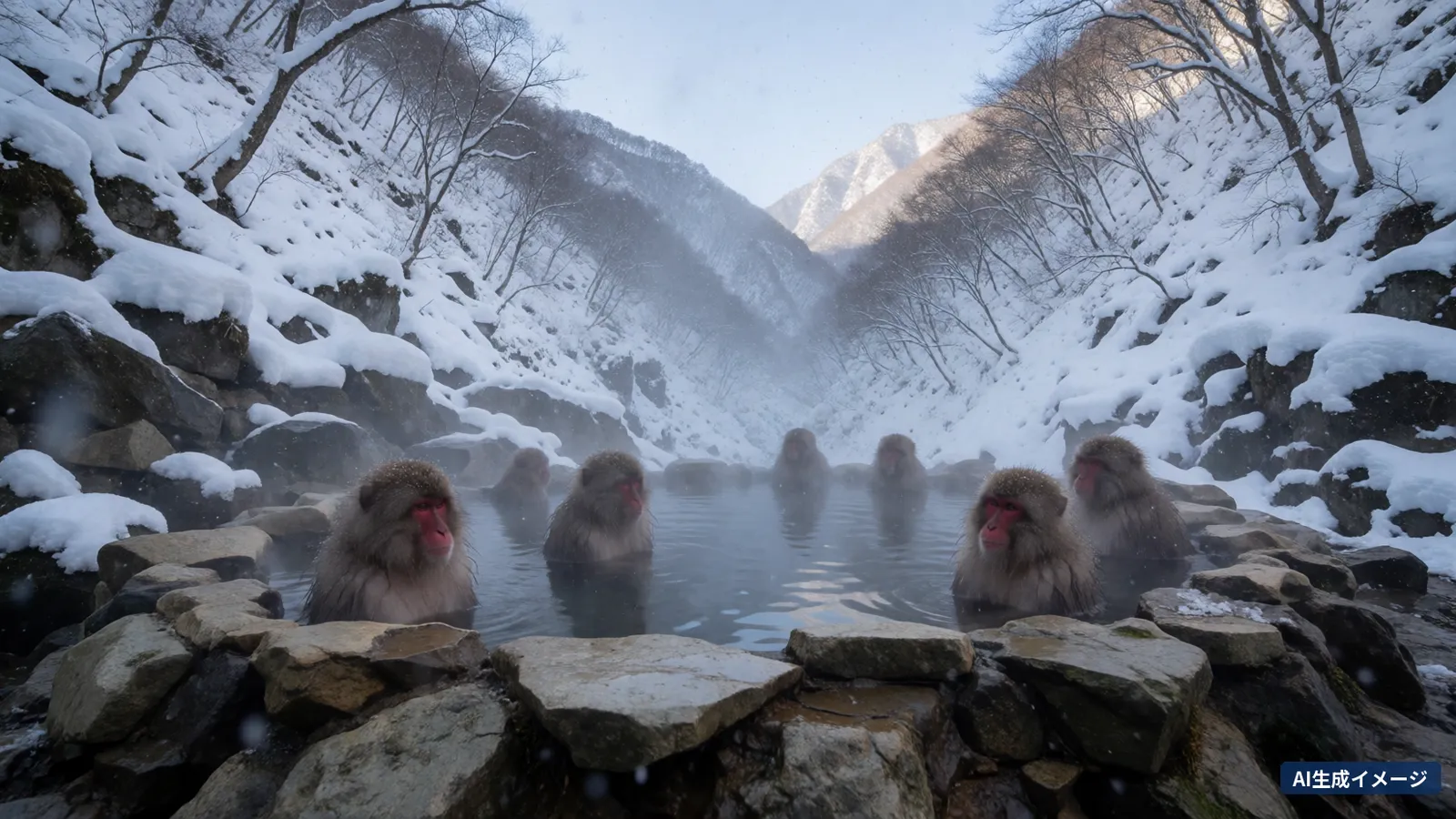
In Japan you can see wild monkeys up close at sights such as Jigokudani, and Asian black bears are seen in mountain areas such as Nagano. On a mountain walk a big family strings out, and the children and grandparents drift apart. With monkeys and bears you use your eyes in opposite ways, so agree the family rules before you start walking.
*This article contains no affiliate links. It is compiled neutrally from public sources and official information.
The answer firstThe answer first: with monkeys and bears, your eyes do opposite things
The answer: do not stare at a monkey from close up; with a bear, keep your eyes on it and back away slowly. Mix these up and you will do the wrong thing. Before you start walking, explain the difference to the children and grandparents.
Summarised from Jigokudani Monkey Park's official "Notes for visitors", the Ministry of the Environment's "What to know about bears before visiting a national park" and Nagano Prefecture's releases (as of October 2026).
Do not show or give food to the monkeys at Jigokudani
The answer: monkeys that get used to being given food by people cling round your feet and snatch bags, so neither show food nor give it.
- The monkeys at Jigokudani are wild Japanese macaques, not separated from visitors by cages or fences.
- The park draws the monkeys with feed, but that does not mean visitors may feed them. Put snacks away in your bag, packet and all.
- People who do not keep to the rules may be asked to leave the park. Dogs and other pets are not allowed in, including assistance dogs.
Do not touch or startle the monkeys, or stare at them from close up
The answer: touching or startling a monkey can lead to threats or bites, and staring at one from close up is taken by monkeys as a sign of hostility.
- Opening your mouth wide at a monkey is also taken as a sign of hostility.
- When a baby monkey feels in danger, it calls the adults. If a curious baby monkey comes up to you, move away quickly.
- These are the rules of the park at Jigokudani. If you meet wild monkeys at other sights, act on the same idea.
- Photos and flash are allowed, but holding a phone or camera too close to the monkeys, putting a camera into the hot spring, selfie sticks and drones are not.
Walking as a big family: do not let the children run on ahead
The answer: with a large family the line stretches out, so on mountain paths where you cannot see far ahead, do not let the children run in front; walk together at the grandparents' pace.
1. One adult at the front and one at the back One way a family can do it
Even if the line stretches, everyone stays in sight. Agree with the children in advance: "if a baby monkey comes up, we move away together with an adult".
2. Stay together at the grandparents' pace From the Ministry of the Environment and Nagano Prefecture
To avoid meeting a bear, too, it matters that no one walks off alone. Keep snacks in your bag while you walk.
3. Do not pick plants or catch animals Park official site
There are venomous snakes and wasps, and plants with thorns or poison. Walk without touching them.
- For getting to Jigokudani and walking the mountain path in winter, see A day at Jigokudani Monkey Park from Nagano Station with a big family.
To avoid meeting a bear, make noise and walk together
The answer: let bears know people are there, with a bell, a radio, clapping or talking. Not walking alone matters too.
- Take extra care where you cannot see far, along streams, on windy days and on rainy days. Nagano Prefecture also asks people to be careful in the early morning and evening, and near thick undergrowth where you cannot see far.
- Bear spray cannot be taken on a plane, either in the cabin or in checked baggage. If you want to carry it, find out first where you can get it after you land, and how to use it.
If you meet a bear, back away slowly while watching it
The answer: do not go closer; keep calm and back away slowly, watching the bear. If you turn your back and run, it may chase you.
- Do not go closer, even for a photo. Do not shout. Do not throw bags or stones.
- Do not try to get past; wait until the bear goes away.
- Nagano Prefecture also advises: "keep your eyes on the bear and slowly move away from the spot". Do not mix this up with "do not stare from close up" for monkeys.
Nagano's "bear sighting advisory" means more sightings than in a normal year
The answer: an advisory is a notice Nagano Prefecture issues for areas where, for example, sightings in places people live have reached 1.5 times a normal year or more. When someone is injured in a place people live, it can become a "warning".
- In 2026, advisories were issued for the Matsumoto area, the Kita-Alps area (including Hakuba Village) and the Kiso area. The Kita-Alps area (after a person was injured in Omachi City) and the Kiso area were raised to warnings in June and July.
- No advisory or warning for the Hokushin area, where Jigokudani is, or the Nagano area, where Nagano Station is, appears in Nagano Prefecture's releases from April to October 2026 (checked on 16 October 2026). One could still be issued, so check Nagano Prefecture's announcements before you go.
- In September 2026, Nagano Prefecture judged the risk of bears coming out in large numbers this autumn to be low. Even so, in some areas they may come into places where people live.
- You can see where bears have been sighted on Nagano Prefecture's "Asian black bear information map".
Honest caveats (4 things we could not confirm or have not written)
These are things we have not been able to verify, so we do not assert them.
Future advisories for the Hokushin and Nagano areas
Up to 16 October 2026, Nagano Prefecture's releases show no advisory for the Hokushin area, where Jigokudani is, or the Nagano area, where Nagano Station is. Whether one will be issued is unknown, so check Nagano Prefecture's announcements before you go.
How to use the Asian black bear information map
We confirmed the map exists, but not how to use its screens or how recent the sightings on it are.
Bear notices on the Jigokudani path
We have not confirmed whether there are bear warning signs on the path to the park. If there are signs on site, follow them.
Numbers of injuries and sightings
The numbers change a lot depending on when they are announced, so this article does not give them.
Wild monkeys and bears (big family) FAQ
If we go to Jigokudani in winter, do we need to worry about bears?
We cannot say there is nothing to worry about. Nagano Prefecture notes that when spring comes early, bears may also wake from hibernation early. Even in winter, keep the same rule of making noise and walking together.
What if a child wants to touch a monkey?
Do not let them. When a baby monkey feels in danger it calls the adults, which can lead to threats or bites.
What should we do if a bear attacks?
The Ministry of the Environment advises lying face down and protecting your neck, face and stomach. Before that, the important thing is to back away slowly while watching the bear as soon as you meet it, and not to turn your back and run.
📍 One of the articles in our Nagano trip plan (Nagano | Trip plan for large families / all Tips articles)