At Shinjuku Gyoen, decide the day first.
Full bloom moves by 13 days, and entry for 6 is ¥1,500
Shinjuku Gyoen is a national garden run by the Ministry of the Environment, within walking distance of Shinjuku Station. From the early cherries in January to the double-flowered ones in late April, about 900 trees of about 70 varieties bloom in turn. But full bloom in Tokyo shifts by almost two weeks from year to year, and on blossom-season weekends some hours are closed to anyone without a booking. This article is for deciding first which day, what time and through which gate a family of 6 goes in.
This article contains promotional content (PR). We include Klook affiliate links for booking airport transfers, transport tickets, experiences, and luggage delivery. If you book through these links, we may earn a commission to help run the site (at no extra cost to you). Options not covered by our partners, such as JR and other public transport, are compared neutrally.
Choosing the dayWhen is full bloom? Decide from 10 years of records
The answer: if you are in Shinjuku in the last week of March, you would have hit full bloom, or close to it, in most of the last 10 years. But the earliest year was 22 March and the latest 4 April: a 13-day spread.
- Tokyo's flowering and full-bloom dates are observed by the Japan Meteorological Agency (JMA) on the sample tree at Yasukuni Shrine.
- The normal dates (the 1991–2020 average) are flowering on 24 March and full bloom on 31 March. The average full-bloom date over the last 10 years is 27 March, about 4 days earlier than normal (calculated from the observations).
- In 8 of the last 10 years, full bloom came by 31 March. The two years it slipped into April were 2017 (2 April) and 2024 (4 April).
- From flowering to full bloom took 6–12 days (6–9 days in 9 of the 10 years).
Full-bloom dates from the JMA phenological observations (Tokyo, sample tree at Yasukuni Shrine). The dotted line is the normal date (1991–2020 average). Checked in September 2026.
| Year | Flowering | Full bloom |
|---|---|---|
| 2017 | 21 Mar | 2 Apr |
| 2018 | 17 Mar | 24 Mar |
| 2019 | 21 Mar | 27 Mar |
| 2020 | 14 Mar | 22 Mar |
| 2021 | 14 Mar | 22 Mar |
| 2022 | 20 Mar | 27 Mar |
| 2023 | 14 Mar | 22 Mar |
| 2024 | 29 Mar | 4 Apr |
| 2025 | 24 Mar | 30 Mar |
| 2026 | 19 Mar | 28 Mar |
How far Tokyo's full-bloom date moved over the last 10 years (22 March to 4 April).
Plan your trip around this spread, and check the JMA flowering announcement just before you go.
- Inside the garden, the peak can differ a little from the JMA full-bloom date. In 2026, JMA declared full bloom on 28 March, while the garden reported Somei-yoshino “at their best throughout the garden” on 3 April.
- The Monday trap: the garden is normally closed on Mondays (or the next weekday if Monday is a public holiday), but it opens on Mondays from 25 March to 24 April. Mondays up to 24 March and from 25 April are closed, so in an early year you cannot get in on a Monday in late March, nor on a late-April Monday while the double-flowered cherries are still out.
At Shinjuku Gyoen, something is still blooming even if you miss full bloom
The answer: with about 70 varieties from early to late bloomers, you can still build a day around the double-flowered cherries in April, after the Somei-yoshino have fallen.
- Somei-yoshino: about 300 trees (the most in the garden), late March to early April. The blossoms reflected in the Middle Pond are the highlight.
- Ichiyo (double-flowered): about 100 trees, early to mid April. The garden says they start to bloom just as the Somei-yoshino finish. They are mostly in the Landscape Garden.
- Kanzan (double-flowered): about 70 trees, mid to late April, around the Central Rest House and elsewhere.
- What actually happened in 2026 (National Gardens Association bloom reports): Ichiyo were at their best on 10 April; by 17 April the garden as a whole was shedding petals, but the Kanzan and Fugenzo between the Central Rest House and Starbucks were still out.
- Other spring flowers: magnolia and Thunberg spiraea in March; azaleas and dogwoods in April.
- If you want to combine this with the Ueno Park cherry blossoms, see our one-day plan for Asakusa and Ueno.
How much for 6: children free, grandparents at a discount
The prices in this article are for a family of 6: two parents, two children (elementary school) and two grandparents.
The answer: junior high and under are free and those 65 or over pay ¥250, so it is ¥1,500 for 6 (¥2,000 if the grandparents are under 65).
| Family make-up | Total entry |
|---|---|
| 5 (two parents + 1 child + two grandparents 65+) | ¥1,500 |
| 6 (two parents + 2 children + two grandparents 65+) | ¥1,500 |
| 7 (two parents + 3 children + two grandparents 65+) | ¥1,500 |
| 7 (three grandparents 65+ + two parents + two toddlers) | ¥1,750 |
| Grandparents under 65 | +¥250 per grandparent (¥2,000 for 6) |
Entry for 6 (grandparents 65 or over).
The two children are junior-high age or younger, so they enter free.
- Entry fees (official): adults ¥500 / 65 or over ¥250 / students (high school and above) ¥250 / junior high and under free.
- If your make-up is different: however many children you bring (up to junior high), the total does not change. A high-school student adds ¥250 (in the 2024 notice, students had to show a student ID and those 65 or over a document showing their age).
- How to pay: you can tap a transport IC card directly on the entry gate. At the ticket machines and staffed windows you can pay in cash, by credit card (JCB, VISA, MasterCard, Diners Club, American Express), with electronic money such as transport IC cards, or by QR code payment (PayPay, Alipay+, WeChat Pay and others) (National Gardens Association entry guide). If you buy a web ticket on your phone in advance, you hold the QR code to the gate and skip the ticket queue (valid for 6 months from purchase).
- Families coming by car can use the car park beside Okido Gate (¥600 for 120 minutes, then ¥200 per 30 minutes, up to ¥2,900 per day). However, the garden asks visitors to use public transport during the cherry-blossom season.
Do you need to book? Families with children did not, even on booking days (2026)
The answer: in 2024–2026, booking was needed only 10:00–16:00 on blossom-season weekends, and parents or guardians with children of junior-high age or younger could enter without booking even during those hours. The garden says it may use bookings “mainly on weekends and public holidays”, so check that year's announcement for the days (1–3 March in 2024–2026).
- Booking days in 2026: Saturday 28 and Sunday 29 March, Saturday 4 and Sunday 5 April, 10:00–16:00. No booking was needed 9:00–10:00 or 16:00–17:30, and there was no booking on weekdays.
- Who could enter without booking: junior high and under / parents or guardians with children of junior-high age or younger, and pregnant women (not groups) / annual pass holders / holders of a disability certificate and one carer.
- Bookings are a timed-entry e-ticket, online only (return postcards and fax were dropped from 2026). According to the 2026 official notice, from 10:00 to 16:00 on booking days you needed this timed-entry e-ticket or a group booking ticket to get in (except for those exempt from booking); the advance web ticket valid for 6 months from purchase was not enough. In the 2024 and 2025 press releases, entries were first come, first served, with a cap on numbers for each hour.
- In 2026, Saturday 4 April was switched to no booking required the day before because of the weather forecast, and on 6 April the garden announced that “this year's cherry-blossom advance booking has all finished”. Booking days can change through official notices up to the day before.
- Grandparents: the official pages do not say whether grandparents count as “guardians”. If you want the whole family to go in together on a booking day, going in 9:00–10:00 or after 16:00 means nobody needs a booking. If you will enter between 10:00 and 16:00, buying timed-entry tickets for the grandparents in advance is the safe option.
Buy your entry tickets in advance
For 6, the two children enter free. With tickets bought in advance, you skip the ticket queue and hold a QR code to the gate.
The Klook ticket is an advance entry ticket (valid 180 days, no cancellation; checked on Klook in October 2026). It is not the “timed-entry e-ticket” needed 10:00–16:00 on booking days (except for those exempt from booking, per the 2026 official notice). Check prices and availability on the booking page.
Which gate to use: Sendagaya Gate on busy days
The answer: in the 2026 cherry-blossom season, the garden warned that Shinjuku Gate and Okido Gate would be very crowded and asked visitors to use Sendagaya Gate, where it said there was generally no wait. On busy days, go in through Sendagaya Gate (5 minutes' walk from JR Sendagaya Station).
| Gate | Nearest station and walk | Best for |
|---|---|---|
| Sendagaya Gate | JR Sobu Line Sendagaya Station, 5 min / Toei Oedo Line Kokuritsu-Kyogijo Station Exit A5, 5 min | Busy days (in 2026 the garden said there was no wait) |
| Shinjuku Gate | JR, Keio and Odakyu Shinjuku Station South Exit, 10 min / Shinjuku-sanchome and Shinjuku-gyoemmae stations, 5 min | Quiet days |
| Okido Gate | Marunouchi Line Shinjuku-gyoemmae Station Exit 2, 5 min (the car park is next to this gate) | Days you come by car |
- If you are staying near Shinjuku Station, on quiet days walk from the South Exit to Shinjuku Gate (10 minutes). On busy days, take the JR Chuo-Sobu Line (local) two stops from Shinjuku to Sendagaya (4–6 minutes on the train), then walk 5 minutes to Sendagaya Gate.
- The garden publishes step-free routes from the stations to each gate (Shinjuku Station Southeast Exit to Shinjuku Gate, Sendagaya Station to Sendagaya Gate, and others).
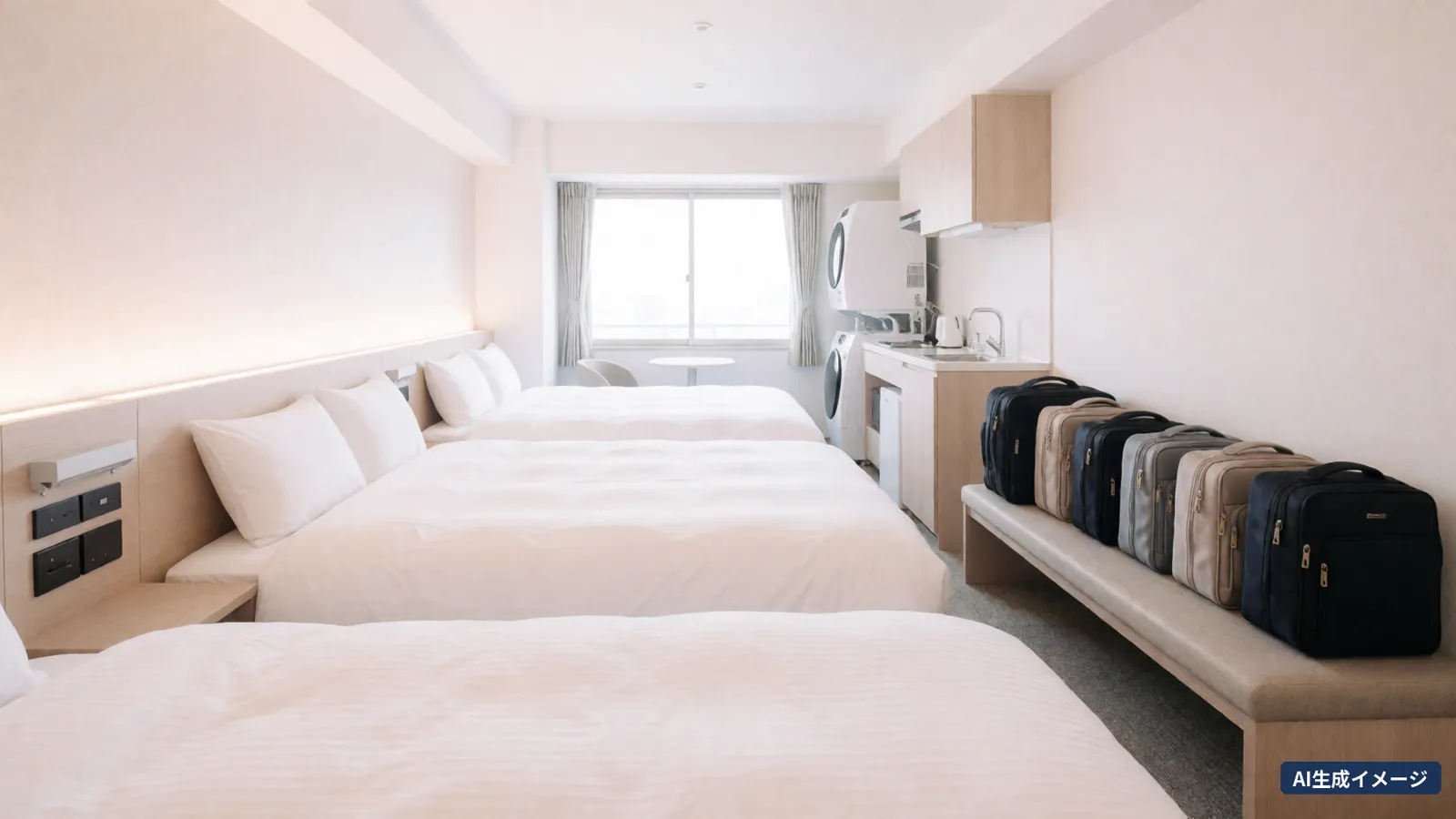
- For choosing where to stay, see places in Shinjuku where a family of 6 can share one room.
Places to rest for grandparents and small children
The answer: wheelchairs can be borrowed free at every gate. There are also indoor places to rest and 8 toilets you can enter with a stroller.
1. Grandparents: free wheelchairs on the day Officially confirmed
Wheelchairs can be borrowed free on the day at the ticket office of each gate and at the service centre. The official universal design (UD) map shows slopes, steps, stairs and gravel paths (parts of the Formal Garden and the Japanese Garden).
2. Small children: 8 toilets you can enter with a stroller Officially confirmed
14 toilets have a baby seat to sit your baby in, and 8 of them, the multipurpose toilets, can be entered with the stroller. Changing tables are in the multipurpose toilets and nursing rooms. There are 4 nursing rooms (women only; hot water for formula from the restaurant). Stroller hire is not mentioned on the official pages, so bring your own.
3. Rain or cold: indoor shelter Officially confirmed
Information Center (9:00–18:00), Greenhouse (9:30–17:30), Shinjuku Gyoen Museum (9:00–18:00). There is also a children's rest area, Mori no Ie (the Forest House).
- Eating and resting (hours in the cherry-blossom season): café (inside the Information Center, 9:00–18:00, takeaway available) / Starbucks (overlooking the Middle Pond, 9:00–17:30) / Restaurant Yurinoki (11:00–15:30) / free rest house (9:00–18:00).
- Not allowed in: alcohol / bicycles, balance bikes, tricycles and unicycles / trolleys and carts that take up 5,000 cm² or more when used / insect nets and insect cages. Tents and parasols cannot be put up.
- Where children can play: ball games are not allowed. But in the Children's Square (Kodomo Hiroba), children of elementary-school age and younger may use soft rubber balls for small children and skipping ropes.
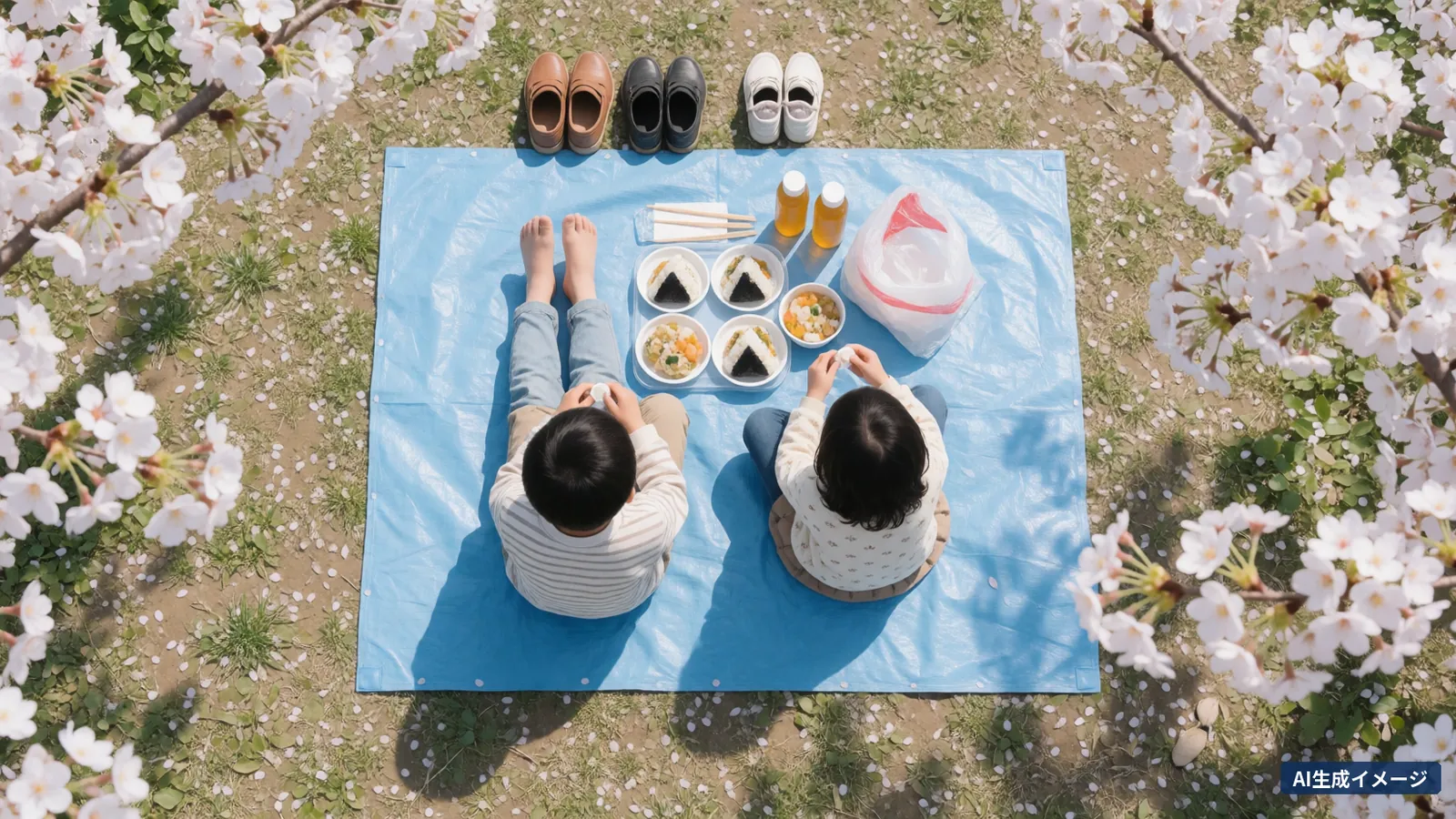
- Picnic rules differ from park to park. See cherry-blossom picnic rules differ from park to park.
Two ways to plan the day
The answer: around full bloom, “go in first thing, leave in the late afternoon, and see the night blossoms at Shinjuku Central Park”. If you miss full bloom, “start around midday and build the day around the double-flowered cherries” is enough.
| Plan | When | How the day goes |
|---|---|---|
| A: around full bloom | Late March to early April | 9:00 in through Sendagaya Gate (no booking needed 9:00–10:00 even on booking days) → morning: Somei-yoshino around the Middle Pond → midday: rest at the café, free rest house or museum → afternoon: Japanese Garden and Landscape Garden → 17:30 last entry, 18:00 closing → evening: night illumination at Shinjuku Central Park (in 2026, 20 March – 12 April, 16:00–22:00) |
| B: after the petals fall | Early to late April | Enter before noon → Ichiyo in the Landscape Garden (early to mid April) and Kanzan near the Central Rest House (mid to late April) → Greenhouse → leave in the late afternoon. Open on Mondays only until 24 April |
| Rainy day | ― | Build the day around the indoor spots (Greenhouse, museum, Information Center), and go out to the Middle Pond when the rain stops |
- Another place for night blossoms: the night illumination at Chidorigafuchi (in 2026, 26 March – 6 April, sunset to 21:00, along a promenade of about 700 m). On weekends during that period the path was one-way from the Yasukuni-dori side.
- The garden closes at 18:00, so you cannot see the blossoms there at night (there was no announcement of evening opening in 2026).
- The 2027 illumination dates have not been announced yet. In 2026, Shinjuku Central Park ran 20 March – 12 April and Chidorigafuchi 26 March – 6 April. The dates move with flowering, so check that year's official announcements.
- For getting from the airport to Shinjuku, see Haneda or Narita to Shinjuku with a family of 6.
On a day without blossoms or in the rain, two indoor options
The answer: on days when you miss full bloom, or when it rains, switch to one of two indoor places reachable from Shinjuku on a single train. Both are places to book for a set date before you go.
- Warner Bros. Studio Tour Tokyo – The Making of Harry Potter: 20 minutes direct from Shinjuku to Toshimaen Station on the Toei Oedo Line, then 2 minutes on foot. Entry is by timed booking (there are same-day tickets, but the time you want may be sold out). Prices vary with the date and time of your visit; for entries from 1 July 2026, adults (18 and over) from ¥6,600, juniors (12–17) from ¥5,500, children (4–11) from ¥4,000, and 3 and under free (choose the infant ticket). For 6 (4 adults and 2 elementary-school children), from ¥34,400. Strollers are allowed, and you can also borrow one free inside (for ages 1–48 months, up to 20 kg).
- Sanrio Puroland: about 30 minutes from Shinjuku to Tama Center Station by Keio Line limited express. To get in you need both a visit reservation and a passport (entry ticket). Prices vary with the date of your visit; adults are 18–64, children and seniors (3–17 and 65 or over) pay less than adults, and 2 and under are free. Grandparents aged 65 or over fall in the same band as children. Book on the official site.
Book the Harry Potter Studio Tour for a day without blossoms
The price for 6 depends on the date of your visit, so enter the date and the number of people to check.
Check prices and availability on the booking page. Prices and age bands are from each official site as of October 2026.
Honest notes (4 things we could not confirm or did not cover)
These are things we have not been able to verify, so we do not assert them.
Busiest times
The garden does not publish this. About the only clue is that bookings apply 10:00–16:00 on weekends.
Whether grandparents count as “guardians”
Parents or guardians with children of junior-high age or younger need no booking, but the official pages do not say whether grandparents are included.
Stroller hire
Neither the Ministry of the Environment nor the National Gardens Association mentions stroller hire on its official pages. Plan to bring your own.
Bloom forecasts
No forecast for flowering or full bloom in 2027 has been published yet (as of October 2026). In 2026, Tokyo flowered on 19 March and reached full bloom on 28 March (JMA). Forecasts are issued by private companies, and this article does not cover them. Plan your trip around the full-bloom spread (22 March – 4 April), and check the JMA flowering announcement just before you go.
Shinjuku Gyoen cherry blossoms with a big family: FAQ
We are going as a family of 6 on a Saturday at the end of March. Do we need to book?
Even on the 2026 booking days (28 and 29 March, 4 and 5 April, 10:00–16:00; 4 April was switched to no booking the day before), parents or guardians with children of junior-high age or younger needed no booking. The official pages do not say how grandparents are treated, so if the family goes in together 9:00–10:00 or after 16:00, nobody needs a booking.
Can we get around with 3 grandparents and 2 toddlers (7 people)?
Entry is ¥750 for the 3 grandparents (65 or over) plus ¥1,000 for the 2 parents, ¥1,750 in total; toddlers are free. Wheelchairs can be borrowed free at each gate, and you can go in through Sendagaya Gate, where the garden said there was no wait in the 2026 blossom season. There are indoor places to rest, so you can take breaks as you go.
Can we bring an 18-month-old in a stroller?
The garden has 8 multipurpose toilets you can enter with a stroller and 4 nursing rooms. Parts of the Formal Garden and the Japanese Garden have gravel paths, so use the UD map to choose paved routes. Stroller hire is not mentioned on the official pages, so bring your own.
Can we see the blossoms at night?
The garden closes at 18:00. After you leave in the late afternoon, you can go on to the night illumination at Shinjuku Central Park, west of Shinjuku Station (until 22:00 in 2026), or at Chidorigafuchi (until 21:00 in 2026).
Is the garden open on Mondays?
It is normally closed on Mondays (or the next weekday if Monday is a public holiday), but from 25 March to 24 April it opens on Mondays too. Mondays up to 24 March and from 25 April are closed.
📍 One of the articles in our Shinjuku trip plan (Shinjuku | Trip plan for large families / all tickets and experiences articles)