The Autumn Takayama Festival & Shirakawa-go Foliage, With Your Big Family.
A viewing and day-trip guide for families with kids
Here's the bottom line: stay multiple nights in Takayama and run a two-track plan — "make the daytime the star of the festival and keep the evening low-key, then visit Shirakawa-go on a separate day-trip bus tour" — and even a big family of 5 or more can enjoy both the autumn Takayama Festival and Shirakawa-go's fall foliage on a single trip. The autumn Takayama Festival (the Hachiman Festival) is held on October 9 and 10 every year, and watching is free. Shirakawa-go's gassho-zukuri village is also free to enter — the more people in your family, the bigger the benefit of a trip where "just looking" costs nothing.
At the same time, the official guidance warns that "the festival period draws very heavy crowds." In this article, we lay out the day-and-evening schedule, tips for viewing with kids, and concrete ways to fit Shirakawa-go into a separate day trip — within what we could confirm from primary sources.
This article contains promotion (PR). We include Klook affiliate links for booking airport transfers, transport tickets, experiences, and baggage delivery. If you book through a link, we may receive a commission to help fund the site (at no extra cost to you). Items outside our partnerships, such as JR and public transport, are compared neutrally.
3 reasons3 reasons "daytime festival, separate-day foliage" works for big families
The daytime karakuri dedication needs little walking and it's easy to slip away official
Each karakuri dedication runs a few tens of minutes, twice a day. Watch from the back of the shrine grounds, and when the kids get bored, switch to the float procession along the main approach. It's a time slot with far less risk for children than the evening festival at night.
Both the festival and Shirakawa-go are free to watch and enter
Watching the autumn Takayama Festival is free, and entering Shirakawa-go's gassho-zukuri village is free too. The more people in your family, the bigger the benefit of a trip where "just looking" costs nothing.
A separate-day day trip hands off big-group travel
Visit Shirakawa-go on a day-trip bus tour on a different day from the festival. You can hand off seat reservations and itinerary management for a large group entirely, so you won't have to fret over coordinating transfers on local route buses.
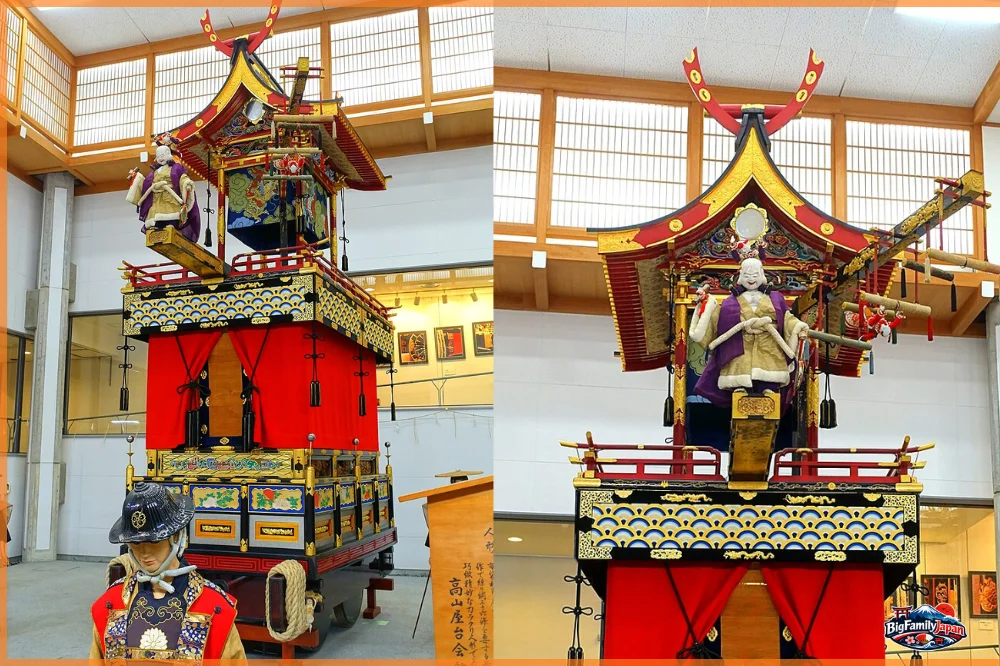
A total of 11 nationally designated festival floats take part.
Watching is free, so even a big family can see them without hesitation.
The autumn Takayama Festival's dates and schedule (October 9 and 10 every year)
Bottom line: narrow it down to two "events to watch" in advance. The festival's events are spread from morning to night, and chasing them all is a sure way to wear the kids out. (The following is a typical-year guide. Schedules change from year to year, so check that year's official announcement for the latest.)
- Dates: October 9 and 10 every year (fixed dates in most years; the day of the week varies by year). The venue is around Sakurayama Hachimangu Shrine (Sakuramachi, Takayama City).
- Float procession: 9:30–17:00 on the 9th / 9:30–16:00 on the 10th. A total of 11 nationally designated festival floats take part.
- Karakuri dedication (Hoteitai float): from 12:00 and 14:00 on the 9th / from 11:00 and 13:00 on the 10th. A few tens of minutes per show, twice a day on both days.
- Goshinko (festival procession): 13:20–15:30 on the 9th / 8:30–12:00 and 13:30–16:00 on the 10th.
- Yoimatsuri (evening festival): 18:15–20:30 on the 9th. All 11 floats, lit with lanterns, parade through the old townscape at night (the evening event is on the 9th only).
- Watching is free. No paid seating is officially announced (= plan around standing room as the default).
A viewing plan for big families with kids: build around the daytime karakuri dedication
Bottom line: for a big family, the main event should be the daytime karakuri dedication plus the float procession, and treat the evening festival as an optional bonus depending on the kids' energy. Daytime involves less walking and it's easy to slip away, and it carries far less risk with children than the nighttime crowds.
- The karakuri dedication runs a few tens of minutes, twice a day. Enter the Sakurayama Hachimangu Shrine grounds a bit before the start time and watch from a spot at the back — that suits families with kids. When they've had enough, you can switch to the float procession along the main approach (which you can watch while walking at your own pace).
- Strollers tend to get stuck inside a wall of people. Carry preschoolers in a baby carrier, and assign "an adult in charge of holding hands" for the older kids, so your group doesn't fall apart even with a lot of people.
- If you go to the evening festival (from 18:15 on the 9th), go in with a "we won't see all of it" mindset. Watching just part of the parade route and heading back to your lodging before the kids get sleepy is the realistic approach.
- This is where where you stay matters. Staying in central Takayama makes a "daytime → nap at the lodging → head back out in the evening" schedule possible. For a base where up to 6 can take a whole house, see our guide to a whole-house machiya in Takayama (sleeps 6). Festival days draw "very heavy crowds" even by the official account, so we recommend booking your lodging early.
- If this is your first trip to Japan from overseas, routing via Chubu Centrair Airport (Centrair) → Nagoya to reach Takayama is the most straightforward. For getting from Nagoya without a car, see our Limited Express Hida + Nohi Bus transport guide. Even if you enter via Tokyo or Osaka, you can head to Nagoya first and join the same route.
- On mornings when the festival isn't on, the Miyagawa Morning Market (daily 7:00–12:00, at the time of writing) and Sanmachi Street (the old townscape, free to stroll) are go-to options with kids.
Get Shirakawa-go's foliage too with a "separate-day day trip"
Bottom line: the best answer for a big family is to visit Shirakawa-go on a day-trip bus tour, on a different day from the festival. The gassho-zukuri village is free to enter and visiting is basically during the day (8:00–17:00) = a good fit for a day trip, and a tour lets you hand off bus booking and transfers for a large group entirely.
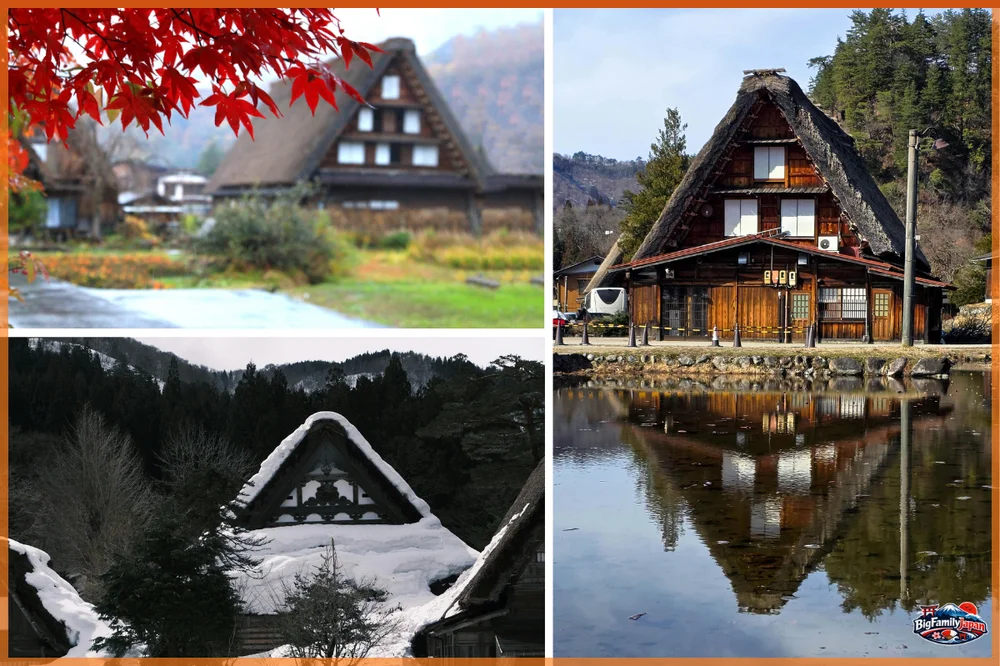
- Peak foliage is roughly late October to early November (the tourist association's guidance is late October to mid-November, and it tends to run later in some years). Since it doesn't line up with the festival (Oct 9–10), you either split the trip — "festival week in Takayama," "peak foliage in Shirakawa-go" — or, for a single trip, shift toward mid-to-late October to aim for the early colors.
- Ogimachi's gassho-zukuri village is free to enter. To the Tenshukaku observation deck overlooking the whole village, a shuttle bus runs from in front of the Wada House (every 20 minutes from 9:00 to 15:40, no service in the noon hour; adults 300 yen / children 150 yen, cash only / at the time of writing). You can also walk up (it's a slope — treat the time as an estimate and check in advance).
- Highlights in the village: Deai Bridge (a 107 m pedestrian suspension bridge), and gassho-zukuri houses open to the public (admission 300–400 yen per person; the Gassho-zukuri Minka-en open-air museum only is 800 yen). The Wada House is 400 yen for adults, 200 yen for elementary schoolers, and free for young children (at the time of writing).
- People live in this World Heritage village. Visiting for non-overnight guests is within the 8:00–17:00 window — an official courtesy worth keeping together with your kids.
- With a Nagoya round-trip day bus tour paired with Takayama, even a big family can hand off bus seat reservations and itinerary management all at once. Please check fares, duration, and child pricing on the booking page.
A picture of out-of-pocket costs for a big family (2 adults + 3 elementary schoolers, a family of 5)
Strolling the village costs 0 yen. Visiting the Wada House comes to 400 yen × 2 + 200 yen × 3 = 1,400 yen, and a one-way observation-deck shuttle bus comes to 300 yen × 2 + 150 yen × 3 = 1,050 yen. Just by "limiting yourselves to 1–2 paid sights," even a party of 5 can keep sightseeing costs quite low (an estimate calculated from official fees at the time of writing, cross-checked in our QA2).
Two options: a festival-day plan / a Shirakawa-go day-trip plan
Festival day at Takayama and a Shirakawa-go day trip are plans with different aims. Get the two formats down first, then combine them to fit your departure dates.
Takayama Festival: daytime-focused plan (Oct 9 or 10)
Karakuri dedication + float procession ・ free to watch ・ minimal walking
- Enter the grounds before the start and watch from a spot at the back
- When the kids tire, switch to the float procession on the main approach
- Treat the evening festival as a "bonus" — go in not planning to see all of it
- Stay in central Takayama so a "nap → head back out in the evening" plan works
Shirakawa-go fall foliage day-trip plan
Free village entry ・ visiting 8:00–17:00 ・ leave it to the bus tour
- A Nagoya round-trip day bus tour handles seats and the itinerary
- Limiting visits to 1–2 sights keeps out-of-pocket costs down even for a big group
- Peak foliage is roughly late October to early November
- Non-overnight visitors strictly keep to the 8:00–17:00 visiting courtesy
| Priority | Recommended timing | How to enjoy the festival | How to enjoy Shirakawa-go |
|---|---|---|---|
| Festival first | Time your Takayama stay to Oct 9–10 | Fully watch the daytime karakuri dedication + float procession | Drop in for the early colors only (don't chase peak) |
| Foliage first | Shift your trip to late October–early November | Enjoy the morning market and Sanmachi Street rather than the festival | Make full use of a day tour at peak foliage |
A guide as of the time of writing. Please confirm the latest dates and fees on each official site.
How to scheduleFestival in Takayama, foliage in Shirakawa-go: a schedule idea for getting both on separate days
The Takayama Festival (Oct 9–10, around Sakurayama Hachimangu Shrine) and Shirakawa-go's foliage (roughly late October to early November) differ in both area and peak timing. Staying multiple nights in Takayama, wrapping up festival day within the Takayama area, and taking a day trip to Shirakawa-go on a separate day keeps travel and energy budgeting simple.
This is a conceptual (schematic) diagram. It pictures a schedule that stays multiple nights in Takayama, wraps up festival day within the Takayama area, and day-trips to Shirakawa-go on a separate day. Actual schedules and travel times vary by season, departure point, and tour details.
Check the Shirakawa-go + Takayama day-trip bus tour on your phone
A round trip from Nagoya that handles bus seats and itinerary management for a large group all at once. Please confirm the latest fares, duration, and child pricing on the booking page.
Please confirm fares, duration, and child pricing on the booking page. Since festival days (Oct 9–10) and peak foliage don't line up, choose your tour date to match your goal.
Honest downsides: we'll name the weak points upfront
Both the festival and Shirakawa-go suit big families, but here honestly are the points around weather, seating, and crowds where people tend to get stuck.
Worries to clear up before you book
Do you need tickets or paid seats to watch the autumn Takayama Festival?
Watching is free. Since no paid seating is officially announced (at the time of writing), plan on standing room; with kids, we recommend claiming a spot early for the daytime karakuri dedication.
I'm worried my child could get lost in the crowds. What can we do?
Stick to three things: 1) decide one easy-to-find meeting point ahead of time, such as "in front of the torii gate at Sakurayama Hachimangu Shrine"; 2) have your child carry a card with your lodging's name and a parent's phone number; 3) always hold hands during the evening festival at night and don't aim for the very front of the crowd. Since events can be cancelled in rain (with no makeup date), don't forget to check the official announcement on the day.
Can you see both the Takayama Festival and Shirakawa-go's foliage on one trip?
Because their peaks don't line up (festival = Oct 9–10; foliage = roughly late October to early November), getting both perfectly requires committing to a priority. If you prioritize the festival, visit on Oct 9–10 and enjoy Shirakawa-go's "early colors." If you prioritize the foliage, shift your trip to late October–early November and enjoy Takayama's non-festival charms like the morning market and old townscape. Either one is realistic.
To Shirakawa-go, is it easier for a big family to go on their own or by tour?
For 5 or more, a tour wins out. Local route buses require arranging seats and transfers for each person, but a Nagoya day-trip bus tour covering Takayama + Shirakawa-go lets you hand off seating and the itinerary entirely. For the route if you go on your own, see our Limited Express Hida + Nohi Bus transport guide.
Once the festival and foliage are set, here's what's next
📍 This article is part of our Takayama & Shirakawa-go trip plan ・ See the list of things-to-do articles