In Japan, popular places need booking ahead
Here's the bottom line: popular restaurants, traditional kaiseki places and hands-on workshops in Japan run on advance booking. Turning up on the day rarely works for a large party. Families of five or more find it harder than small groups to get a table or a slot, and often meet "fully booked" or "finished for today". This guide covers how to tell what needs booking, and how to lock it in for everyone at once.
This article contains no affiliate links. It is an independent column written to help large families travelling in Japan, based on general practice rather than any particular venue. Booking requirements differ from place to place, so please confirm with each restaurant or venue directly.
Why you can't get inWhy large families run into "fully booked" more often
Bottom line: where seats and capacity are fixed, the blocks big enough for a large party are the first to go.
Tables that seat six together are scarce
There are plenty of tables for two to four, but far fewer that seat six or more together, and workshop slots for a large group are limited too. Popular places fill early, and asking for "a table for six" on the day is the request most likely to be turned down. If you would rather not be split up, book it in one go.
In peak season, weeks ahead can be too late
Around public holidays, cherry blossom, autumn leaves and festivals, restaurants, experiences and hotels fill especially fast. Check availability as soon as your dates are set.
Booking lowers the language barrier
Booking online or through your hotel's concierge means less to negotiate in person. You can also state party size, allergies and whether you need a high chair in advance.
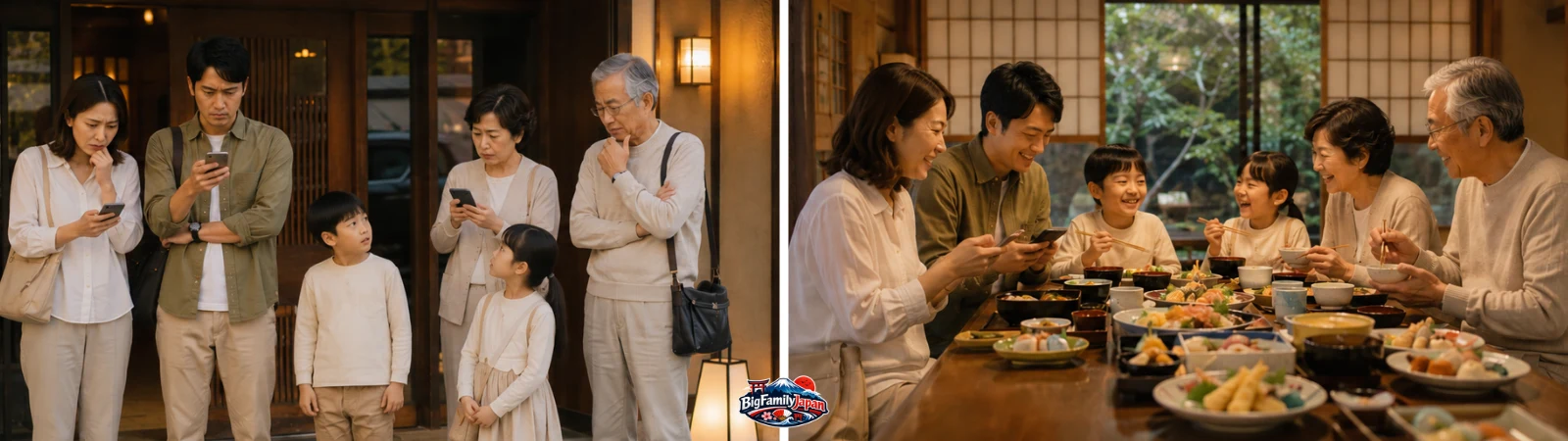 AI-generated image
Book for everyone in a single reservation and you avoid both "no room today" and being split across tables.
Three ways to book for the whole family at once
Bottom line: between online booking, your hotel's concierge and advance-booking sites, you can secure large-party slots even if you would rather not make a phone call.
- Online booking sites: multilingual sites let you pick party size, date and whether you need a high chair — and they work at any hour
- Your hotel's front desk or concierge: many will book popular restaurants and experiences for you. Ask at check-in and it moves quickly
- Advance booking for experiences: for kimono, crafts and activities, reserving every place at once avoids sold-out stock and queueing on the day
Book ahead or walk in? A simple chart
When in doubt, ask whether the seats or slots are fixed. If they are, book. If it is somewhere you can drop into, leave it for the day.
Fixed seats or capacity (popular restaurants, experiences, peak-season stays, reserved seats) need booking; places you can drop into (street food, parks, most shrines) work on the day. Requirements differ by venue, so confirm with each one.
Honest caveats
Booking ahead is powerful, but here are the traps that catch large families in particular.
Booking culture in Japan: FAQ
We are six — can we just walk into a popular restaurant?
Often not. Tables for two to four may be free, but tables seating six or more together are limited, and popular places tend to be fully booked on the day. If you would rather not be split up, book for everyone in advance.
How far ahead should we book?
It depends on the venue and season, but booking popular restaurants and experiences a few weeks ahead is a safe guide. In peak periods — public holidays, cherry blossom, autumn leaves and festivals — they fill even faster, so check as soon as your dates are set.
Can we book without making a phone call?
Yes. Multilingual booking sites let you choose party size, date and whether you need a high chair. You can also ask your hotel's front desk or concierge to arrange or advise on bookings.
What should we do with the hours we could not book?
Keep places that need no booking — market street food, parks and gardens, most shrines and temples — as your fallback. Even if you cannot get every reservation, the family's day still holds together.
Read next: planning a trip to Kanazawa
📍 Part of our good-to-know guides